Saturday, 23 March 2024

Worksheet:The Artist of the Floating World

Hello readers!!

  An Artist of the Floating World

This blog is part of the Thinking activity task of the worksheet of The Artist of the Floating World. 

Worksheet 1.1: Author and title 

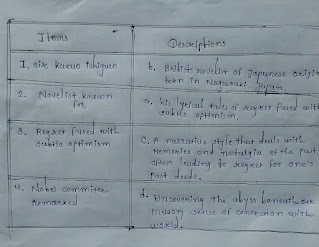
Match the following:

Match the following items related to Kazuo Ishiguro with their descriptions.
1)Who is V S Naipaul,and what is he known for ?
V. S. Naipaul, full name Sir Vidiadhar Surajprasad Naipaul, was a Trinidadian-British writer of Indian descent. He was awarded the Nobel Prize in Literature in 2001. 

Naipaul is known for his novels, essays, and travelogues exploring themes of colonialism, identity, and post-colonialism. Some of his notable works include "A House for Mr Biswas," "A Bend in the River," and "The Enigma of Arrival." He's also recognized for his distinctive prose style and incisive observations of human behavior and cultural complexities.


2. What is the book "Good Muslim" about? Also mention the author & country.
The book "Good Muslim" is a novel written by Tahmima Anam, who is from Bangladesh. It explores the aftermath of Bangladesh's war for independence through the lives of its characters, examining themes of identity, religion, and political upheaval.


3. What is "The Lowland" about?


"The Lowland" is a novel written by Jhumpa Lahiri, an American author of Indian descent. It tells the story of two brothers from Calcutta, Subhash and Udayan, whose lives take dramatically different paths. Set against the backdrop of India's Naxalite movement, the novel explores themes of family, identity, love, and sacrifice.


4. Who is the author of ‘Island of Thousand Mirrors and to which country does s/he belongs to?
The author of "Island of a Thousand Mirrors" is Nayomi Munaweera, who is from Sri Lanka.

5. Explain the significance of the title of the novel ‘An Artist of the Floating World’ in a few words:

The title "An Artist of the Floating World" suggests the transient nature of life and the protagonist's shifting moral perspectives, mirroring Japan's post-war societal changes.


Worksheet:2 


1. Explain these quotes: Write context and significance on separate paper.


(A) “As far as I am concerned, I freely admit I made many mistakes. I accept that much of what I did wasultimately harmful to our nation, that mine was part of an influence that resulted in untold suf eringfor our own people. I admit this.” Speaker: ______________________ to:_______________________.


Masuji Ono to Saito Family

(B) "There's a certain kind of artist these days," he went on, "whose greatest talent lies in hiding awayfrom the real world. Unfortunately, such artists appear to be in dominance at present, and you, Ono,have come under the sway of one of them. Don't look so angry, it's true. Your knowledge of the worldis like a child's. I doubt, for instance, if you could even tell me who Karl Marx was."Speaker: ______________________ to: _______________________ .


Mastuda to Masuji Ono


(C) "Was Mr Naguchi like Oji?" --- Oji, why did Mr Naguchi kill himself?". Speaker: _______ to ______.

Ichiro to Masuji Ono


(D) “My conscience, Sensei, tells me I cannot remain forever an artist of the floating world." --- Then hsaid: "As you point out yourself, Ono, these are troubled times. All the more so for a young artist,practically unknown.” Speaker: _______________________ to____________________

Sensei to Ono


2. Explain this painting: [Keywords to search about it in novel – ‘Complacency’, ‘Eyes to the Horizon’.]


This painting is about nationalist propaganda. In the left corner, there are three poverty-stricken children. One has a rifle, another has a sword. He is pointing towards West Asia for war. In the top right, there are three prominent political leaders. At the back, there is a flag of Japan. In the top left, there is the new dawn of New Japan. In Japanese language, it is written "No time for cowardly talking," which means Japan must move forward. No longer is there a backdrop of poverty, but military fame of the rising sun of Japan. And that is how it turned into "Eyes on the Horizon."


3. What is the significance of the word "you" in the novel?

In "An Artist of the Floating World," the use of the word "you" carries significant thematic weight, particularly in relation to the protagonist, Masuji Ono. Throughout the novel, the narrative is framed as Ono addressing an unnamed "you," which can be interpreted in several ways:

Self-reflection and introspection: 

Ono's use of "you" may symbolize his internal dialogue, as he reflects on his past actions and their consequences. By addressing himself as "you," he creates a sense of distance, allowing for a more objective assessment of his own behavior and motivations.

Addressing the reader: 

The use of "you" could also be interpreted as Ono speaking directly to the reader, inviting them to consider their own role in the narrative. This engages the reader in the process of moral inquiry and self-examination, prompting them to reflect on their own beliefs and values.

Collective responsibility: 

Ono's use of "you" may suggest a broader commentary on collective responsibility and the interconnectedness of individuals within society. By addressing the reader as "you," Ono implicates them in the larger social and political context of post-war Japan, highlighting the shared burden of reckoning with the past and shaping the future.

Overall, the significance of the word "you" in the novel underscores themes of self-reflection, moral accountability, and the complex interplay between individual actions and societal norms.


4. What do you understand about ‘Unreliable Narrator’ ? 


In "An Artist of the Floating World," Masuji Ono serves as an unreliable narrator, meaning that his perspective on events and characters may be skewed or incomplete. Here are some aspects of Ono's unreliability as a narrator in the novel:

Subjectivity: 

Ono's narration is deeply subjective, colored by his own biases, perceptions, and motivations. He presents events and characters through his own lens, which may distort the truth or omit important details that do not align with his worldview.

Self-deception: 

Ono is prone to self-deception, particularly when it comes to confronting his past actions and their implications. He rationalizes his involvement with nationalist propaganda during World War II and downplays his role in perpetuating harmful ideologies, which can lead the reader to question the accuracy of his account.

Selective memory: 

Ono's memory is selective, and he often remembers events in a way that casts himself in a favorable light or justifies his actions. He may omit or distort details that contradict his desired narrative, leading to an incomplete or biased portrayal of events.Unreliable interpretation: Ono's interpretation of events and characters may be unreliable, as he interprets them according to his own preconceived notions and personal agenda. 


5. The Art and the Artist: How is this concept explored in the novel? [Key: How Masuji’s father, Master Takeda - a business owner, Chisu Mastuda – a nationalist friend and Seiji Muriyama - teacher consider the role of art? Mention it in a few words. Do not write lengthy answer]


Masuji's father views art as a respectable but financially unsustainable pursuit. Master Takeda believes in the importance of traditional Japanese art but prioritizes practicality over artistic ambition. Chisu Matsuda sees art as a tool for promoting nationalist ideals and social cohesion, advocating for artists to align their work with the government's agenda.

Seiji Muriyama, Masuji's former teacher, values art for its ability to challenge societal norms and provoke thought, encouraging Masuji to push artistic boundaries and explore new forms of expression.


6. Which theme according to you is the central theme of the novel? [Just mention the theme. No need to write in detail about it]


The central theme of "An Artist of the Floating World" is the nature of memory and its impact on identity.


Thank you...

References :Chat GPT 

Friday, 22 March 2024

The act : Auden 's Poem

Hello readers!!

         W.H.Auden's worksheet 
This blog is written as a part of worksheet about W.S.Auden's poem.

Worksheet -1  

Title: Using ChatGPT to Analyze Auden's Poem "September 1, 1939"


         "September 1, 1939"
   

September 1, 1939" is a poem by W. H. Auden, reflecting on the outbreak of World War II. The poem is rich in imagery and explores themes of disillusionment, political turmoil, and the search for meaning in a chaotic world. Auden wrote the poem shortly after the invasion of Poland by Nazi Germany, and it was first published in The New Republic in October 1939.

The poem begins with a vivid description of the scene in a bar in New York City, where the poet finds himself on the eve of the war. It captures the sense of foreboding and uncertainty that pervaded the atmosphere at the time. 

The poem then delves into deeper themes, exploring the failures of modern civilization and the moral decay that led to the conflict. Auden reflects on the rise of totalitarianism and the loss of individual freedom in the face of oppressive regimes.

One of the most famous lines from the poem is "We must love one another or die," which encapsulates the poet's plea for humanity to find unity and compassion in the midst of chaos and destruction. 

However, the poem also acknowledges the difficulty of achieving this ideal, as the forces of hatred and division seem to be overpowering.

 Here is the link of poem on YouTube video
 
Worksheet-2  
W.H. Auden's poem 'September 1, 1939'

1. What is the setting of the poem?

The setting of the poem is a dive bar on Fifty-second Street in New York City.

2. What is the mood of the poem?

The poem feels unsure and scared, like something bad is about to happen.

3. What is the significance of September 1, 1939, in the poem?

September 1,1939, is the date when Germany invaded Poland, which marked the beginning of World War II. 

4. What is the theme of the poem?

-Loss of innocence, 

- Rise of totalitarianism,

- The search for meaning in a world fraught with chaos and uncertainty.

5. What is the role of history in the poem?

-The poem acknowledges the weight of historical events and their impact on the present moment. 

-Drawing parallels between the turmoil of his time and past conflicts. 

-The poem also critiques the failures of history to prevent the rise of totalitarianism and the devastation of war, highlighting the cyclical nature of human suffering and the perennial struggle for peace and justice.

-Auden's reflection on time and history was crucial during the start of World War II.

6. Explain the line "We must love one another or die."


By stating "We must love one another or die," Auden suggests that without love and empathy, humanity risks self-destruction. It's a call to recognize our shared humanity and the need to transcend differences to create a better world. The line underscores the importance of compassion, understanding, and cooperation as antidotes to the forces of hatred and destruction that threaten to tear society apart.

7. What is the significance of the "Ironic points of light" in the poem.

The light stand in contrast to the darkness of the events unfolding the outbreak of World War II. They represent civilization and human activity juxtaposed against the impending chaos and destruction.

suggests a dual nature, hinting at both hope and despair. While the lights may represent human achievement and resilience.

They represent pockets of hope and humanity in a time of crisis.


8. Write explanation on any one stanza of the poem. The poem is linked in the teacher’s blog.

I sit in one of the dives On Fifty-second Street Uncertain and afraid As the clever hopes expire Of a low dishonest decade: Waves of anger and fear Circulate over the bright And darkened lands of the earth, Obsessing our private lives; The unmentionable odour of death Offends the September night.


In this stanza of "September 1, 1939" by Auden, the poet conveys his sense of fear and uncertainty amidst the end of a deceptive and disappointing decade. He describes how global turmoil, symbolized by waves of anger and fear, infiltrates people's daily lives, both brightened and darkened by circumstances. The stanza ends with a haunting image of death's presence in the September night, encapsulating the pervasive atmosphere of apprehension and foreboding before the outbreak of World War II.


Thank you....

Be Lerner..


"1984" film Adaptation Screening Worksheet

Hello readers!!
"1984"  film Adaptation Screening Worksheet


 This blog is written as a part of worksheet activity about the 1984 by George Orwell. In the blog various questions which answered briefly with the help of Chat GPT.

Worksheet:1)


Worksheet:2)

About the film adaptation of novel and some questions regarding the film:

Part 1: Pre-Screening

1. Have you read the novel "1984" by George Orwell? If yes, what did you think of it? If no, what do you know about the story?

I'm familiar with the novel "1984" by George Orwell. It's a dystopian novel set in a totalitarian society where the government, led by the Party and its leader Big Brother, surveils and controls every aspect of people's lives, including their thoughts and actions. It's a powerful exploration of themes like government oppression, surveillance, and the loss of individual freedoms.


2.Have you watched any adaptations of "1984" before? If yes, which ones and what did you think of them? If no, what do you expect from this adaptation?


After understanding of novel then wwatch the film adaptation of novel Nineteen Eighty-Four, also known as 1984, is a 1984 daystopian drama film written and directed by Michael Radford basesed upon George Orwell 's 1984  novel of the same name.The 1984 film adaptation directed by Michael Radford is particularly notable for its faithful adherence to the source material and compelling performances, capturing the oppressive atmosphere of Orwell's world. For any adaptation, I expect a faithful representation of the themes and messages of the novel, as well as compelling performances from the cast to bring the characters to life.


3.What themes or ideas do you think are central to "1984"? Why?

"1984" by George Orwell explores themes of totalitarianism, surveillance, manipulation of truth, individual freedom, and the dangers of oppressive governments. These themes are central because they reflect Orwell's concerns about the abuse of power, the erosion of personal liberties, and the potential for society to descend into dystopia if unchecked authority goes unchallenged. The novel serves as a warning against the dangers of authoritarianism and the importance of preserving individual autonomy and truth in society.


Part 2: Screening


1. As you watch the film, take note of any major differences from the novel. How do these changes affect the story?

In adaptations of "1984," some major differences from George Orwell's novel might include alterations to the plot,Changes like these can impact the story by either enhancing certain aspects, simplifying complex themes, or altering the overall message.


For example, some adaptations may emphasize the romantic relationship between Protagonist Winston and Julia more prominently than the original novel, while others downplayPolitical aspects to focus more on action or  visual spectacle. 

These changes   can  affectIterpretation reception of the story by audiences, potentially leading to a different understanding or appreciation of Orwell's original themes and ideas.

Another difference we find is beginning of the novel  and film. 

"It was a bright cold day in April, and the clocks were striking thirteen. Winston Smith, his chin nuzzled into his breast in an effort to escape the vile wind, slipped quickly through the glass doors of Victory Mansions, though not quickly enough to prevent a swirl of gritty dust from entering along with him. "

This is the begging of the novel. It sets the tone of dystopian world. The juxtaposition of the Bright And Cool serves as something uneasy is going on. 

The film begins eith the quote highlidhts the theme of the novel. 


2. How does the film's visual style and cinematography contribute to the story? What mood or tone does it create?


Michael Radford's film adaptation of "1984" utilizes a bleak and oppressive visual style and cinematography to effectively convey the mood and tone of George Orwell's novel. 


 Use of Colour:The use of desaturated colors, stark lighting, and claustrophobic settings contributes to a sense of dread and hopelessness, mirroring the oppressive society depicted in the story. 


 Visual style: The film's visual style enhances the themes of surveillance, control, and paranoia, immersing the audience in the oppressive world of Oceania.


Framework :Radford's use of tight framing and confined spaces reinforces the feeling of entrapment and powerlessness experienced by the characters. 

The bleak and dreary landscapes further emphasize the sense of isolation and despair, highlighting the characters' struggle against the omnipresent authority of the Party.

Overall, the visual style and cinematography of Radford's "1984" contribute to the creation of a mood and tone that is dark, oppressive, and unsettling, effectively capturing the essence of Orwell's dystopian vision.


3)Compare the portrayal of the main characters in the film to your mental image of them from the novel. How are they similar or different?

In Michael Radford's film adaptation of "1984," the portrayal of the main characters aligns closely with their descriptions in George Orwell's novel.

Like Winston Smith is depicted as a subdued, weary man grappling with the oppressive regime of Big Brother, reflecting his disillusionment and inner rebellion.

 Similarly, Julia is portrayed as a rebellious and passionate individual, though perhaps with a bit more vulnerability than portrayed in the novel.

 However, due to the limitations of visual adaptation, some nuances and depth of character from the novel may be lost or altered in the film adaptation. 

Overall, while there may be some differences in interpretation, the core essence of the characters remains intact.


4 )What elements from the novel did the film adaptation include or exclude? Were there any major plot points that were left out?


1984," many key elements from the novel are included, such as :
- Oppressive surveillance state
 -The Party's manipulation of truth  
-The forbidden love affair between Winston and Julia
The film captures the bleak and dystopian atmosphere of Orwell's world, including the iconic slogans like "Big Brother is Watching You."

Beside some  elements are inevitably excluded such as:
One major plot point that is somewhat abbreviated in the film is the exploration of Winston's rebellious thoughts and inner turmoil. While the film still portrays his resistance against the Party, some of the novel's depth in depicting his internal struggle and gradual awakening to the truth is streamlined for the screen.

Part 3: Post-Screening

1. What do you think are the strengths and weaknesses of this film adaptation? How does it compare to other adaptations of "1984"?


One strength of the he film effectively captures the oppressive atmosphere and surveillance state, immersing the audience in the grim reality of life under the Party's rule.

However, one weakness of the adaptation is its somewhat condensed portrayal of certain plot points and character development compared to the depth found in the novel.

In comparison to other adaptations of "1984," Other adaptations, such as the 1956 film version directed by Michael Anderson or various stage adaptations, may take different approaches or interpretations, but Radford's film remains a notable and impactful depiction of Orwell's dystopian vision.

2. How successful was the film in conveying the central themes and ideas of the novel? Were there any aspects that the film failed to capture?

The film effectively captures the themes of totalitarianism, surveillance, propaganda, and the loss of individual freedom, which are central to Orwell's work. The portrayal of the oppressive regime, the manipulation of truth, and the characters' struggle against conformity all resonate with the novel's themes.
However, there are some aspects that the film may not fully capture or explore as deeply as the novel. For example, while the film depicts Winston's rebellion against the Party, it may not delve as deeply into his inner thoughts and the complexities of his character as the novel does.


3. What is your overall impression of the film? Would you recommend it to others? Why or why not?

Yes, i recommend movie as well as novel also because there is something difference or important things which we find in the film as well as novel.Despite some scenes, the film captured the essence of the novel well.


Thank you...

Monday, 11 March 2024

Bob Dylan and Robert Frost

Hello readers!!
This blog is part of thinking activity which assign by Vedhehi ma'am about the Bob Dylan and Robert Frost A famous American artist.
                    

            Bob Dylan and Robert Frost 

                        
Here we discuss the various questions regarding the  well known songwriter Bob Dylan and poet Robert Frost.

1) Which is your favorite Poet/Lyricist?
 Why?


Bob Dylan and Robert Frost  both are highly regarded poets and lyricists, each with their own unique style and contributions to literature. 

Among the both  poet or lyricist  Bob Dylan is my favourite poet ,because his  primarily known as a musician and songwriter. He rose to prominence in the 1960s as a leading figure in the folk music revival, and his songs often contain poetic and socially relevant lyrics. Dylan's impact on popular music and culture is immense, and he has been influential across multiple generations.


2) Share some lines from the Bob Dylan songs that you feel are relatable to you. Also, write the themes visible in those lines.

There is the various intresting poems by Dylan like:
"Blowin’ in the wind"
"Like A Rolling Stone"
"All Along the Watchtower"

There we find intresting lines are...

How does it feel, how does it feel?

To be without a home

Like a complete unknown, like a rolling stone


The lines from Dylan song ' The Rolling stone 'where we find that how the poet express the feeling of being lost, directionless, and detached from one's former life. Here we find The repetition of "how does it feel" emphasizes the introspective nature of the question, as the protagonist reflects on the experience of being without a home and feeling like a stranger to oneself "like a complete unknown". The imagery of a "rolling stone" further conveys the sense of aimlessness and constant motion, suggesting a lack of stability and rootedness in one's life. 

As well as  these lines evoke themes like Isolation

Alienation

Search for identity 

Overall, "Like a Rolling Stone" captures the essence of existential  and the experience of losing one's status and identity in a changing world.

3) Share some lines from the Robert Frost poems that you feel are relatable to you. Also, write the themes visible in those lines.


     Robert Frost 

Like Bob Dylan we also find various intresting poems by Robert Frost are:

"Stopping by Woods on a Snowy Evening"

"The Road not Taken ""

" Fire and ice "

There we find one small but interesting poem lines like:

Some say the world will end in fire,

Some say in ice.

From what I’ve tasted of desire

I hold with those who favor fire.

But if it had to perish twice,

I think I know enough of hate

To say that for destruction ice

Is also great

And would suffice.


Fire and Ice" by Robert Frost is a short but powerful poem that delves into the destructive forces of desire and hatred.

The second stanza explores the destructive potential of desire, with "fire" representing the burning intensity of passion and craving that can consume individuals and societies.

the third stanza, Frost shifts to the destructive force of hatred, represented by "ice."


4) Post the picture clicked during the activity and share some lines of any songs from Movies, Poems, or any type of music you feel is relatable to the theme of songs by Bob Dylan and poems by Robert Frost. 


paper 206: African Literature

Hello readers!! This blog task is about Assignment writing on A Limited Woman: Character is in Question in Buchi Emecheta Novel ...